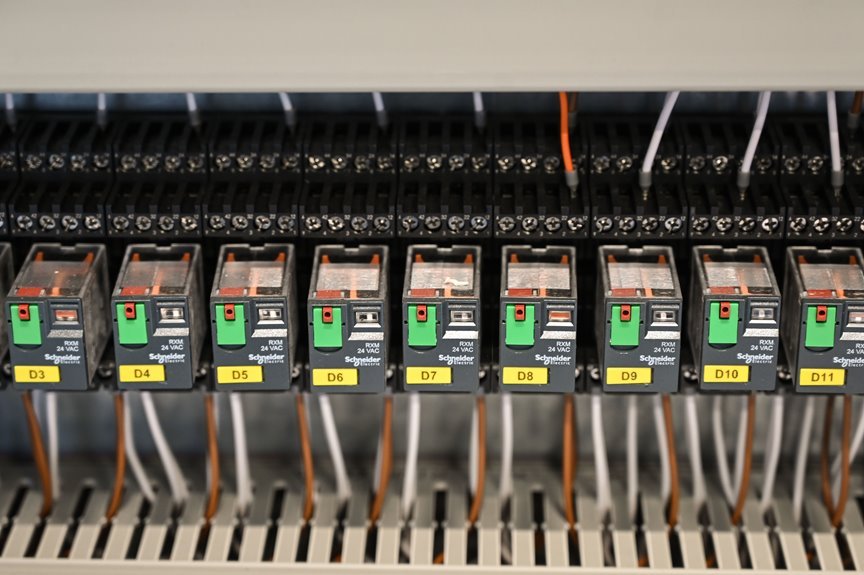
The AetherPulse Relay Matrix proposes a decentralized, edge-aware routing fabric that uses nontraditional signal paths and synchronized timing across distributed nodes. It emphasizes multi-path routing, edge aggregation, and governance-backed safeguards to reduce latency for critical packets while maintaining global convergence. Its architecture combines modular safeguards with dynamic path selection and auditable operations. The proposal invites evaluation against latency, fault tolerance, and cost across edge, cloud, and hybrid contexts, leaving open questions about practical deployment and interoperability.
What Is the Aetherpulse Relay Matrix and Why It Matters
The Aetherpulse Relay Matrix is a proposed network architecture designed to optimize high-speed information transfer by leveraging nontraditional signal pathways and synchronized timing across distributed nodes. It enables flexible, decentralized control and resilience in data transport.
AetherPulse mechanics describe adaptive signal routing, while Latency benchmarks quantify performance gains, informing scalable deployment and governance of heterogeneous networks.
How the 8582513828–6186227546 Constellation Drives Latency Reduction
The 8582513828–6186227546 constellation reduces perceived latency by exploiting synchronized, multi-path routing and distributed edge aggregation, effectively shortening end-to-end travel time for critical packets. It aligns routing with edge nodes to minimize queuing and propagation delays, yielding measurable latency benchmarks. However, these gains introduce scalability tradeoffs, balancing throughput, control complexity, and resource distribution across heterogeneous network segments.
Architecture and Edge-Aware Routing: Capabilities and Safeguards
Architectural design for the AetherPulse Relay Matrix emphasizes edge-aware routing combined with modular safeguards to sustain QoS guarantees. The architecture enables dynamic path selection, local policy enforcement, and latency-sensitive prioritization while preserving global convergence.
Design tradeoffs emerge between agility and predictability. Governance safeguards constrain configuration, ensure auditability, and prevent abuse, sustaining freedom while maintaining interoperability and resilience across heterogeneous edge environments.
Use Cases, Comparisons, and How to Evaluate the System for Your Needs
How does the AetherPulse Relay Matrix perform across diverse deployment scenarios, and what criteria determine its suitability for specific needs? Use cases span edge, cloud, and hybrid networks, highlighting modular scalability and predictable fault tolerance. Comparisons emphasize latency benchmarks and throughput consistency. Evaluation rests on cost benefit analysis, interoperability, and deployment latency, guiding informed decisions toward freedom and purpose-driven infrastructure.
Frequently Asked Questions
What Are Practical Deployment Steps for the Aetherpulse System?
The deployment steps focus on deployment planning and fault tolerance, outlining phased integration, rigorous validation, and resilience testing. It emphasizes modular rollout, continuous monitoring, rollback procedures, and clear governance to ensure reliable, scalable operation for freedom-minded users.
How Does Failure Recovery Affect Real-Time Performance?
Failure recovery reduces real-time performance due to transient latency spikes; however, effective failure mitigation confines disruptions, preserving throughput. Latency impact is bounded by prioritization schemes and redundancy, enabling sustained responsiveness for a freedom-seeking operational posture.
What Security Considerations Exist for Edge Routing?
Edge routing demands rigorous access controls, authenticated sessions, and tamper-evident logs; failure recovery demands secure rollback, integrity checks, and trusted state reconstruction, ensuring resilient, auditable performance without compromising user autonomy or data sovereignty.
Can the Constellation Scale Beyond Current Nodes?
The constellation scalability is limited by node density and consensus latency, but expansion is feasible with incremental topology changes; edge routing security must be preserved, ensuring robust authentication, authorization, and real-time anomaly detection across growing networks.
What Are Licensing and Maintenance Requirements?
Licensing requirements mandate formal authorization and periodic renewals; maintenance schedules specify routine inspections, firmware updates, and uptime targets. The system preserves autonomy while ensuring compliance, with transparent governance and predictable intervals that support flexible, freedom-oriented deployment.
Conclusion
The AetherPulse Relay Matrix presents a robust, edge-aware routing paradigm that balances multi-path resilience with governance-backed safeguards. Its constellation of nodes—streamlined for low-latency, high-throughput paths—offers scalable fault tolerance and transparent operations. While latency gains hinge on dynamic path selection and edge aggregation, the framework remains mindful of cost and interoperability. In short, it acts as a market-accurate compass, guiding distributed networks through a fog of complexity toward calmer, faster horizons.
